

Welcome back to The Stain, an ongoing serial set in the world of What Remains, from Written Ward.
I apologize that this week’s installment was late. We drove my eldest daughter down to Florida where she’ll be attending college. I had thought that I would be able to finish writing this installment in time, but I was wrong.
Whether you’ve been with us since that first trip into the cellar or if you’ve only just found your way to Fenwick, I’m glad you’re here.
This story is meant to be read in order, so new readers—or anyone who might need a refresher can catch the previous episodes by clicking on the links below:
Do Not Clean Glass
The Sock Monkey
One Week
For everyone who’s following along, I hope you’ll share your theories or ideas about what’s going on here. Thank you for being part of this little community. Now, let’s get back to the story.

I came downstairs before daylight and found the cards where I’d pinned them the night before. The few facts I’d documented—SOOT, WHISTLE, RUMBLING, THE MAN, and ONE WEEK—had to mean something.
I spent the next few hours going back through everything we knew. By the time I stopped writing, I’d covered the table with maybe two dozen sheets of paper. Half-formed thoughts. Questions I couldn’t answer. The same facts arranged and rearranged in the hope that putting them in a different order might reveal the connection I’d been missing.
I picked up my cup from the edge of the table and took a sip. The coffee had gone cold already.
I looked out the window and was surprised to see that the sun had risen above the ridge. I couldn’t believe I’d been working that long. The morning light fell across the table and caught the yellow notice the conductor had left there the night before. Nate’s name stood out in crisp black type against the aged paper.
Before Nate went home, he’d complained that my list of cards wasn’t complete. He said I needed to add one more. A card that would read DEATH. I’d refused—only to have the conductor hand-deliver a notice that said as much.
The conductor had to be the key to all of this. But was he tied to the lantern or to the rail line that had once run through Fenwick? Why had exposing the light brought him here? Why did the soot constitute acceptance? And why did he insist that Nate was freight?
I took a fresh card from the stack and wrote FREIGHT. On another, I added the words TENDER CONFIRMED. Then I filled others with the words CONSIGNEE UNASSIGNED, ORDERS REMAIN UNCHANGED, and the time 9:14 P.M. I pinned the new cards beneath the others and stepped back. The cards still didn’t give me an answer, but at least I was beginning to understand some of the questions.
A big question was the lantern’s history. The only thing I knew was that Bessie had bought it from an estate sale in Clay County, but who did she buy it from? Why had she bought it? I doubted that I’d ever learn the why, but I knew enough about their bookkeeping to be reasonably sure I could find out the who. The answer would be in one of Minnie’s notes. That woman documented everything. I went over to her desk and started going through the various drawers, flipping through notebooks, and just digging for some type of record from that year.
The bell above the front door jingled. I jumped and dropped the notebook I was holding. When I turned, Nate was edging sideways through the doorway with a cardboard box in his arms. Minnie followed with one of the old leather-bound ledgers.
“You can get out of my chair right now,” Minnie said. “You’re lookin’ in the wrong place.”
I froze in place like I’d been caught with my hand in the cookie jar. “How do you know what—”
“Because in the two decades you’ve been walking this earth you’ve never shown a single moment’s interest in my records. Now, you’re trying to figure out this lantern. Only makes sense that you’d go looking for the man who owned it before Bessie. Well you can stop looking.” She dropped her ledger on the desk. “The answer’s in here.” Without another word, she flipped the book open to a page that she’d bookmarked and ran her finger across the page until it stopped at a name: Owen Cottrill.
“That’s great. Do you know anything else about him?”
“I do not, but I do have the name of the man who ran the estate sale. Maybe he’ll have more information for you.” Her finger slid to a different column on the same page where I saw the name of the auctioneer: Clyde Monahan.
“Clyde Monahan. I can work with that,” I said. I knew just who to call too.
Nate came over with his box and set it on the table next to Minnie’s ledger. “If you knew the answer was in your ledger, why’d you have me carrying this long box all this way?”
“Two reasons,” Minnie said. “First, there might be something useful in that box. It’s better to have all the information on hand just in case we need it.”
“And the second reason?” Nate asked.
“Because I wanted you to feel useful.”
That caught me off guard and I let out a quick bark of laughter. Nate gave me a cross look and I tried to make it up to him. “Don’t worry, Nate. I have just the job for you. Practically tailor-made.”
“What’s that?”
“I want you to go online and find out everything you can about the train and the railroad that used to be right outside of this place.”
“Yeah,” Nate said with a smirk, “I’m sure somebody digitized forty-year-old train schedules, indexed them, and put them online for the tens of people who might someday care. Probably even gave it an API. You realize the internet isn’t a database of everything that ever happened, right?”
“We don’t need to know everything that ever happened. We just need to find out about the train that used to run past this place—and more specifically the lantern you couldn’t resist touching.”
“Boys!” Minnie said. “Can we get less fighting and more focus?”
After all this time, he still knew how to get under my skin. “You’re right, Grandma. I’m sorry.” I turned away from Nate and rested a hand on the edge of the counter. “Just find what you can, okay?”
Nate didn’t answer, but he pulled a chair over beside the counter and opened his laptop. The glass case full of objects Bessie had said were tainted by sorrow sat at his elbow. I took that as a win.
“Grandma, can you look through all of the receipts and things you brought to try to find any other bits of information you might have about that lantern? I’m going to get on the phone and see what I can find out about Owen Cottrill and that Monahan guy.”
She gave me a brief smile and took her seat at the little worktable beside the register. In a matter of moments she was buried behind a stack of papers and small receipts. Nate was only a few feet away, already staring into his laptop.
I left the two of them working and headed for the front door, passing the coal stove on my way. I paused at the door to look back at them. Between the two of them, it looked like we’d opened some sort of makeshift detective agency. I chuckled and stepped through the open door and stopped beside it. I was still close enough that I could hear Grandma shuffling papers and be there if she called out to me. From there I could enjoy the breeze coming off of the Cherry River. I pulled out my cell phone and dialed.
There were a lot of ways to go about finding the information I needed, but most of them would require too much of the thing that was getting harder to come by: time.
As best I knew, Owen Cottrill was a private citizen. No particular reason anyone in the collectibles business would know his name. I could work the social angle. I did have a couple of cousins up in Clay County. One of them might have known him or someone close to him. That might be a good angle for this, but I figured I’d have better luck going after Clyde Monahan. He ran the estate sale for the Cottrills and Minnie had said he was an auctioneer as well. That put him in a small class of people who were easier to find. More than that, it put him right in my neck of the woods. I knew all the people who would know him.
The phone rang twice and then a loud voice from the other end said, “Hank! How’re you, son? I was so sorrowful to hear about Bessie’s passin’. Believe me when I say the world ain’t had a nicer woman walk its soil than Bessie Parsons. I did a lot of business with her over the years and she was truly a saint of a woman. Now, what can I do for ya?”
All the words came out in one long stream. The man barely stopped to catch a breath, but that was just how Jimmy Doddrill was.
“I appreciate that, Mr. Doddrill. She always spoke highly of you and how knowledgeable you were. ‘Hank,’ she’d say, ‘if you ever need help figurin’ out how much somethin’s worth, you call old man Doddrill. He’ll tell it to you plainly and you can trust his word.’ That’s what she’d tell me.”
“Well, Bessie knew her antiques.”
“She knew people, too.” I smiled. “And I meant to tell you, Lori came to the funeral. Brought us a pie and everything. That was awful kind of her.”
“She’s a single young woman, too. I could put in a good word for ya, Hank.”
“Well, I might just take you up on that someday.” I laughed. “Actually, I was wonderin’ if you could help me find a fella.”
“I sure can try. Who are ya lookin’ for?”
“Name’s Clyde Monahan. Might be out of the business by now and I know it’s a long shot even askin’ you. Minnie told me I was just wastin’ your time even bringing it up. Said I should just go straight to the newspapers and obituaries, but I don’t think she knows how connected you are. Years ago this fella was an auctioneer. He ran estate sales. I don’t know how wide-traveled he was, but I do know he handled a few in Clay County. You ever have any dealings with him?”
“Monahan, you say? Naw, can’t say that name rings a bell with… oh wait. How long ago did you say he was workin’? I think my daddy did trade with a Monahan, but that was back in the seventies. Way before your time, but not before Minnie’s. She should know better.” He paused long enough to laugh and then continued, “Why’re you askin’ about somethin’ as old as all that?”
“Antiques, Mr. Doddrill. Why else would I be askin’?”
“Fair enough,” Jimmy Doddrill said. “Fair enough. Well, I can tell ya right now that Clyde Monahan is dead. He passed goin’ on about three years ago now, I reckon. He left the business to his daughter. Her name’s Allison. I’m happy to give you her number but, Hank, you’ll want to watch out for her. She’s shrewd. If whatever you’re lookin’ for has any kind of money attached to it, she’ll want a piece.”
“That’s good to know, Mr. Doddrill. Not gonna be a problem though. I’m just lookin’ for some information.”
Doddrill laughed. “Boy, don’t you know that’s the most costly thing you can buy?”
“I do know that, Mr. Doddrill. I was hopin’ that she didn’t.”
He laughed again. “Well, you get back to me when you’re deal’s done and tell me how that hope played out. Are you ready for her number?”
He gave me the number, I thanked him, disconnected, and stepped back inside. Grandma had stopped sorting receipts at her table and was staring at me over the stack.
“Couldn’t help hearin’ my name come up. When did I say anything to you about that old coot?”
“You never said a thing, but don’t tell me you don’t believe it.”
She harrumphed. “Still, woulda been nice if you’d asked first.”
“You’re right. And I’m sorry, but it worked. He gave me the number of the person who might know about Clyde Monahan and might still have records about Owen Cottrill. I’m gonna call her…”
“Eh,” Nate said from the counter. “I was wrong.”
I looked over at him. “Wrong? What were you wrong about?”
He turned the laptop toward us. “About how there probably wouldn’t be a lot of information about old trains online. Turns out the people who love trains, really, really love trains. I’ve found at least half a dozen websites devoted to the old B&O Railroad and a couple of Facebook communities for the line that ran right past our door. They called it the Number 4. It ran from Cowen up to Richwood, turned around, and went back to Cowen. Also, I found a mistake on Bessie’s inventory card. She wrote that the trains stopped running in 1987. That’s wrong. The trains didn’t stop running until 1990. A full three years later.”
Grandma pushed the receipts aside. “Now just you hold on. I’m the one who wrote No Line Running on that card and I don’t know what you’re going on about 1990. The trains stopped goin’ through Fenwick in 1987. Anyone who lives here knows that. Just ask any old timer. They’ll tell ya.”
“That’s not what the records I found online say. They all say 1990.”
“I think…” I looked up. “I might know why.” I walked past the stove and turned toward the rows of shelves along the front wall. Behind a row of Mason jars and a bundle of yarrow was an old framed notice.
I shifted the jars aside and pulled the frame free. The paper was sun-faded and frayed at the edges, but the print was still legible behind the glass. It read: INTERSTATE COMMERCE COMMISSION NOTICE OF APPLICATION FOR ABANDONMENT.
“I bought this off a guy up in Webster County three or four years ago. Came out of an old depot. I couldn’t figure out why anybody needed federal permission to stop running a train, so I looked it up.” I carried the sign over to Grandma and Nate so they could see it more clearly. “The railroad could quit running trains through Fenwick before the line itself was officially abandoned, but they couldn’t officially close until Uncle Sam gave them the okay. There’s a whole process to this stuff.”
Nate turned his laptop back around. “Maybe,” he said.
“Maybe?” I repeated and looked toward Grandma to see if she understood him.
“Maybe these people scanned more than schedules.” He clicked through several tabs on his browser looking for the right page. “I know it’s in one of these. I just saw it.” He slapped the table. “There it is!” He angled the screen so we could see.
“Nate, what am I looking at? Is that a train schedule?” I asked.
“This isn’t a passenger timetable. It’s an employee timetable.”
“What’s the difference?” Grandma asked.
“Passengers use one to figure out when their train leaves. Railroad employees use this one to figure out what they’re allowed to do.” He scrolled further down the page. “It explains it all right here. When a new timetable went into effect, it replaced the old one.”
I looked at Grandma again.
Nate noticed my expression. “What?”
“Vallow.” I said the word quietly. Almost like I was afraid saying his name would make the conductor come back. Maybe I was.
“What about him?” Nate asked.
“My orders remain unchanged.”
Nate looked back at his screen, searching the timetable. “Hold on.” He pulled the laptop closer and read the paragraph again.
“What?” I asked.
“This.” He pointed at the screen. “It says when the new timetable takes effect, any train operating under the old one loses its ‘right and schedule.’ That’s what he means by orders. If Vallow died while the old timetable was still in effect, then as far as he’s concerned, nobody ever gave him anything that superseded it.”
“He’s dead, Nate,” Grandma said. “I don’t think the Interstate Commerce Commission is much concerned with whether ghosts have their paperwork in order.”
I edged closer to the counter. “Don’t you see though? What if it doesn’t matter whether the rules actually bind him. What if the thing that matters is that Vallow believes they do.”
“Okay,” Nate said. “So we know why he’s still following the old orders.”
“That don’t tell us how to change ‘em,” Grandma said.
My eyes went to the yellow notice on the table and I felt my gut drop. “The good news,” I said with an enthusiasm I didn’t feel, “is that we still have six days to figure out how to tell a dead man his orders have changed.”
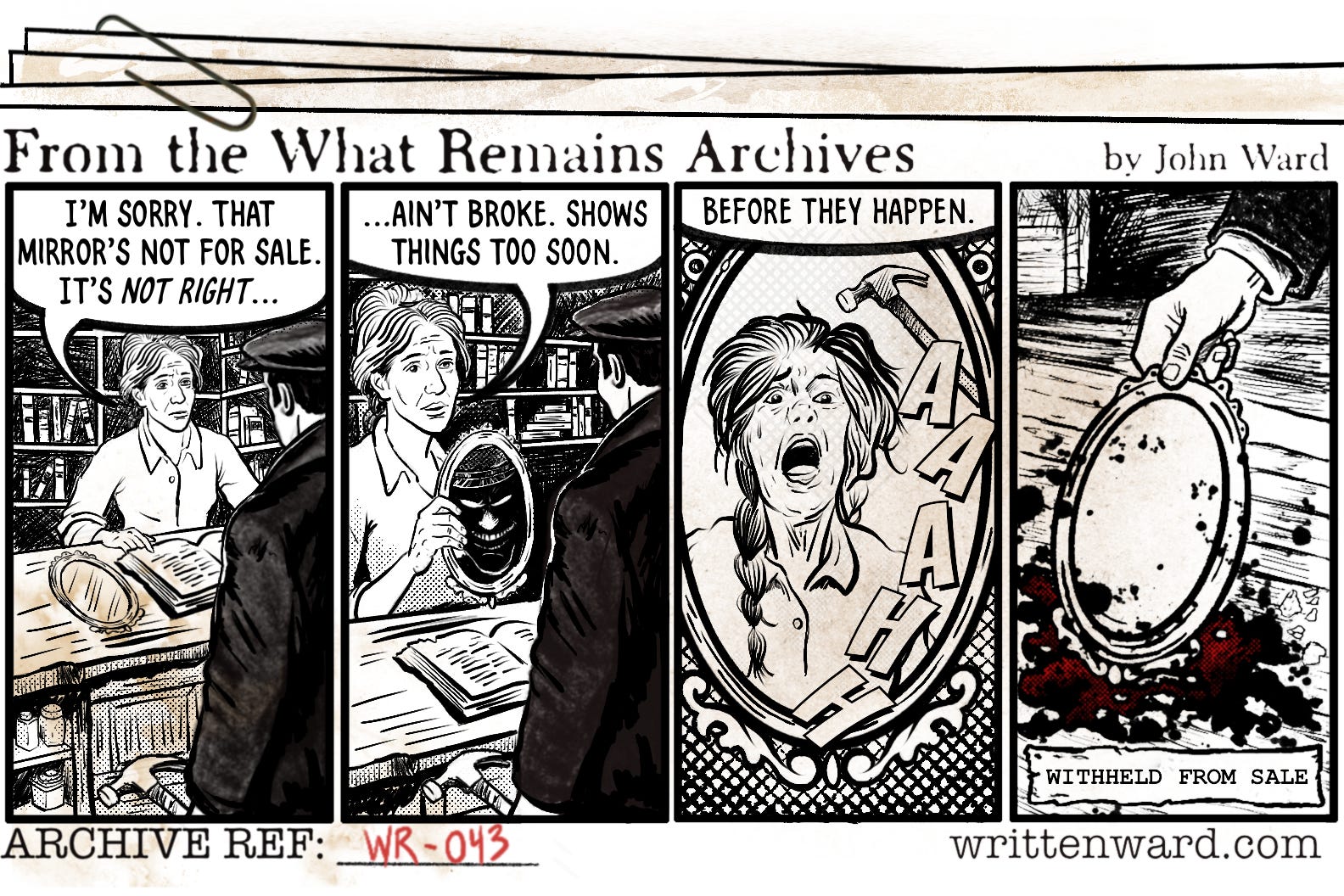
This is something different. I enjoy comics and like making them. So from time to time, I may include short little horror-related (but never extreme) comics like the one above. Do you like things like this? If so, let me know.
Next in Written Ward
Written Ward follows a four-week rhythm during each season. We are in Week Three.
- Week One — Original Fiction: A new installment of What Remains
- Week Two — Spoken Ward: A short story worth discussing, what caught my attention, a few questions for its author, and another story recommended by that author
- Week Three — Original Fiction: The next installment of What Remains
- Week Four — Found Treasures: A personal collection of things I’m glad to have found and people whose work I think deserves attention
That rhythm will continue throughout the season. I’ll announce the season finale and the following intermission in advance.
This week’s newsletter was delayed, but I still plan on releasing my regular edition on Friday. I’ll be back in your inbox in a couple of days with this month’s edition of Found Treasures.

Thank you for reading and for joining us from the beginning.
If this installment made you think of someone who might enjoy a strange little shop and the things locked away in its cellar, please consider sharing it with them. Personal recommendations are how Written Ward finds new readers.
Until next week. Mind the rules!
Cottrill and Doddrill rhyme! Significant? (Hey, you wanted theories…)