

Welcome back to What Remains, an ongoing serial from Written Ward.
Whether you’ve been with us since that first trip into the cellar or if you’ve only just found your way to Fenwick, I’m glad you’re here.
This story is meant to be read in order, so new readers—or anyone who might need a refresher can catch the previous episode by clicking on the link below (Do Not Clean Glass).

For everyone who’s following along, I hope you’ll share your theories or ideas about what’s going on here. Thank you for being part of this little community. Now, let’s get back to the story.

Nate was still waiting for an answer.
Part of the reason I’d spent so much time in the cellar was that Minnie objected to any study of the objects. At all. It wasn’t safe, she said. They were locked away for a reason. I didn’t have the training.
Maybe she was right about all of that. But none of it changed the fact that the cellar had fallen to me. Whether I liked it or not, I was the one expected to keep these things locked away. If I didn’t learn what they were and what they could do, sooner or later something bad was going to happen.
I looked at Nate’s finger and realized that the bad thing was already here and, once again, I didn’t have the answers I needed.
It was Tuesday. I hoped the store would be quiet enough for us to speak privately.
“Come on, Nate. We’re going to have to talk to Grandma.”
I felt four years old again. Off to confess some terrible sin.
We emerged from the cellar to find Minnie in the back room, surrounded by the men and women who stopped in frequently enough that you’d think they were part-time employees.
Regulars. That’s how I always thought of them, but they were something more. They were friends. People who had known Bessie and Minnie for years… some had known them for decades. Now, they’d come to express their sorrow, share fond memories, offer support, and, of course, bring the death food. Someone dies, you just have to bring a casserole. Might as well be a rule.
I closed the heavy door behind me and quickly stepped in front of Nate. Conversation came to an abrupt end as every eye turned to us.
Nate shifted to one side. I moved back in front of him. “Stop moving,” I muttered. “And keep that hand down.”
“Say his name and the Devil appears,” Minnie said to much laughter from her gaggle of friends. Jackie Monroe, from the Post Office across the street, laughed so hard that I thought she was going to pass out.
“We were just talking about you boys,” Minnie continued. “Carl Sizemore, here, hadn’t heard that Bessie had willed What Remains to you boys.”
I nodded to Carl. “Yes, that’s right. Bessie asked us to take care of the place.“
“I’ve lost my father’s watch.” The words came out matter-of-factly as if he expected them to have some kind of meaning to me. When he realized I wasn’t going to answer a question he didn’t ask Carl said, “Bessie would’ve known what to do to get it back. I can’t help but wonder if she passed any of that on to you, son?”
“I’m sorry, but—“
Then I saw Lori Mullenax. She was walking right toward me and wearing the most beautiful smile. I think she even had on a new dress. I’d never seen her wear yellow before.
“Hi Hank,” Lori stepped around me. “Nate, I brought a pie for your family. I know how terrible this loss is and I just had to do something to maybe make things a little easier. It’s cherry. Do you like cherry?”
She held out the pie and Nate reached for it with the wrong hand.
Minnie’s eyes widened. All of her attention fixed on the soot staining Nate’s finger. Before she could say anything, Dessie Collins worked her way over to us. Her cane tapping its way across the worn floorboards.
“Do you boys plan on sellin’ the place,” she asked, “or are you gonna give it a go and run it yourselves?”
I could feel Minnie watching me.
“I want to honor Bessie’s dying wish and keep the place,” I said.
At exactly the same moment, Nate said, “We’re going to get things stabilized and reassess our options.”
Nobody else seemed to notice our contradiction. Minnie was still staring at his finger.
Minnie cleared her throat.
“I’m sorry, everyone, but I’m feeling a little worn down. Would you mind if we continued this tomorrow? I think I need to lie down for a while.”
Tildie Bragg, who had to be in her late seventies, stepped forward and began shepherding everyone to the door.
“Come on, now. Let’s give this family some time to themselves. Minnie needs a nap.” She caught Lori looking back at Nate. “And you can stop mooning over that boy and get on outside. You’ll find out how weariness sneaks up on a person when you get to be my age.”
The room filled with goodbyes and promises to come back soon. Friends and neighbors left, but the covered dishes stayed behind.
Tildie was the last to leave. She paused with one hand on the doorframe and looked back to Minnie. “I don’t know what those boys have done, but don’t be too hard on ‘em.”
“Why do you think—“ I began. “How do you know we did anything?”
Tildie looked at me as if I’d just denied that the sky was blue. I could tell by the way she looked at me that she was getting ready to say something, but then she shook her head and stopped. I thought the matter was over but a mischievous smile crept across her face.
“I don’t think you’re stupid,” she said. “Just young. For all your faults, this town—and this store in particular—needs young people. That Mullenax girl certainly thinks so.” She turned back to Minnie. “Don’t run them off. I couldn’t bear the melancholy performance Lori would put on.”
The door closed behind her.
As soon as the bell stopped ringing, Minnie crossed the room and seized Nate by the wrist. She held his hand beneath one of the overhead lights, turning it until the stained finger was fully exposed. Then she looked at me.
“I told you not to go messin’ around in that cellar. That’s not a place where you work.”
“Grandma, I have to understand what those things—“
“I won’t hear it. You didn’t believe me, and now a big fat gobbler has come home to roost. I told you this would happen. I told you, Hank!” Her voice broke as she said my name.
She released Nate’s hand as if it had burned her.
“What did you do?” she demanded. “Start at the beginning, and don’t leave anything out.”
I helped Grandma over to the seats by the coal stove. She lowered herself into the old rocking chair. It was the one that Bessie had always favored. Seeing Minnie in it made Bessie’s absence hit home in a way that it hadn’t before. Felt permanent now, I guess.
Nate and I took the rigid ladder-backs across from her.
Once she was settled, I told her everything that had happened in the cellar. At first, she listened without interrupting. By the time I reached the lantern though, she had gone still.
“Let me make sure I understand,” she said, “You grew up here. You spent years watching how Bessie treated that cellar. I specifically told you not to spend any more time down there than you had to, and you still decided to ignore all of that.”
“Grandama—“
“But you didn’t stop there. You undid all of the precautions that Bessie herself had put in place. You untied the baling wire?”
“Yes.”
“You unwrapped the lantern?”
“I pulled back enough of the wrapping to see it. That’s all. I didn’t stand it up, and I didn’t light it.”
“You did enough.”
“I know I should have listened.” I leaned forward. “But you recognized the stain the second you saw it. I saw the look on your face when you saw it. There’s something you aren’t telling us.”
She shifted in Bessie’s chair but didn’t answer. She looked at me for a long time. For a moment, I thought she was going to say something but then her gaze returned to the soot on Nate’s finger.
“Won’t wash off, will it?” she asked him.
“No. Doesn’t matter how much I scrub. It’s still there.”
I covered one of Minnie’s hands with mine.
“What’s going on?”
She looked toward the back of the store. “Nate, do you know the storage closet beside the back door? The one just off from the cellar?”
“Yes,” he said.
“Open it and reach onto the top shelf. You’ll find a box there. Bring it to me.”
“Grandma, Nate might be in danger. We don’t have time to—“
“Hank.”
She said it the same way she had when I was a boy and had stepped on her last nerve.
“I need you and Nate to do exactly what I say,” she continued. “I know exactly how much time we have.”
I didn’t like that answer, but it was the first one she had given me. I nodded to Nate and he went for the box.
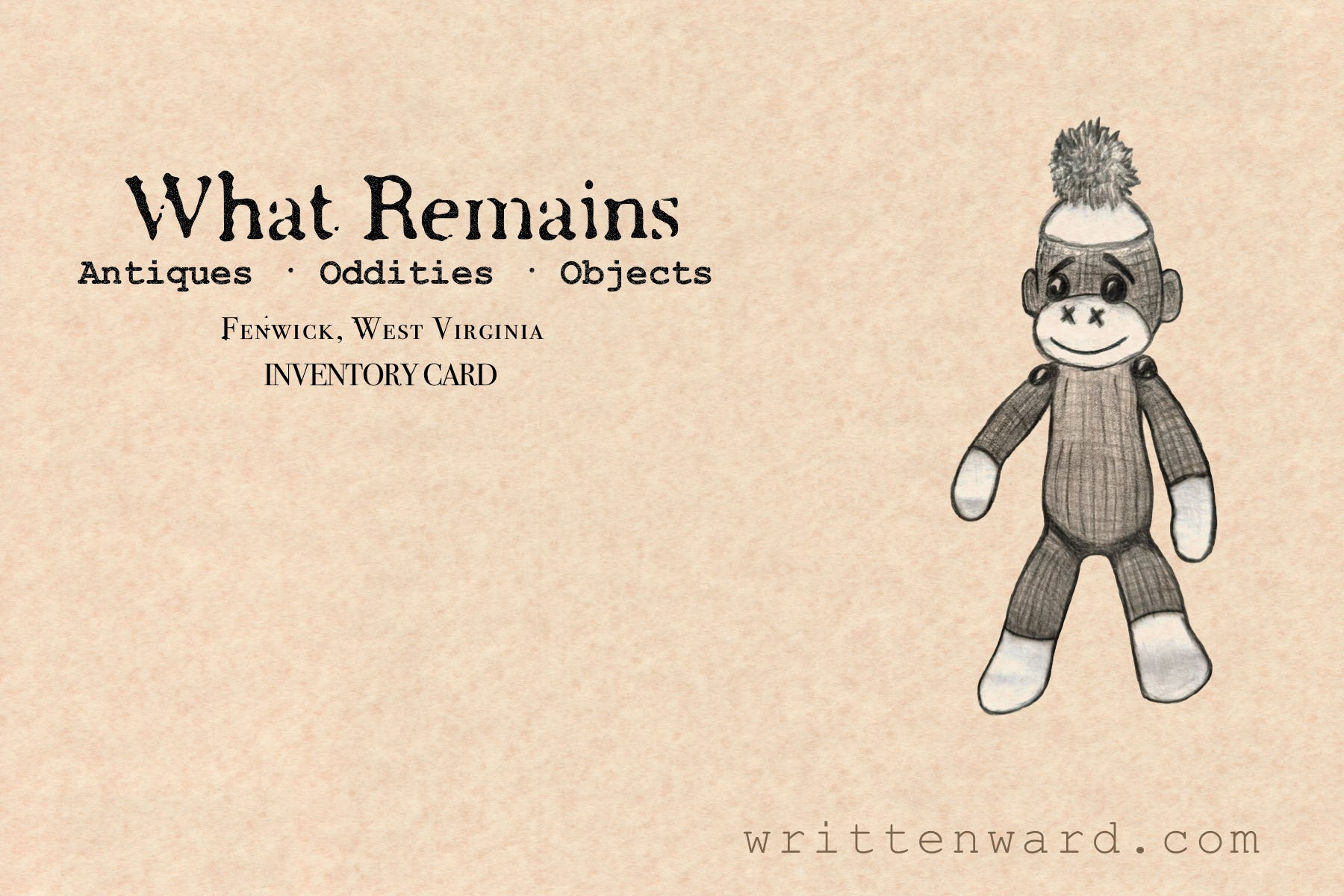
He carried it back and set it on the end table beside the rocking chair. The smell of mildew escaped as soon as Minnie opened the lid. Inside lay a homemade sock monkey, gray and white, with a fuzzy ball on top of its head.
“Whose was it?” I asked.
“It belonged to Bessie’s little girl.”
Nate and I looked at each other.
“You didn’t know,” Minnie said. “Of course you didn’t. Bessie never spoke about her, and it was never my story to tell.”
Her eyes moved once to Nate’s finger.
“Until now.”
“Then tell us,” I said. “But tell me what this has to do with Nate.”
“Hank, you’re a good boy, but I need you to let me speak.”
“I’m trying to keep him safe.”
“I know.” She tightened her arms around the sock monkey. “I am focused on Nate. But first you need to understand our family history with that lantern.”
Minnie ran her thumb along one of the sock monkey’s seams. “That lantern came into our lives when the baby was two years old. No—she would’ve been three by then. Bessie had heard about a collector up in Clay County who died under circumstances she didn’t like. I never did catch the particulars, but she’d traced that lantern’s history right back here.”
“Do you mean she traced it back to Fenwick?” I asked.
She nodded. “It had been used on the B&O line that ran through town. Ran right past this store. The train station used to be right across the road next to the Post Office. Passed through here every day back then.”
“If Bessie thought it was dangerous, why bring it home?”
“She didn’t know. Not then. Not for certain. She was suspicious, and she meant to find out.” Minnie looked down at the monkey. “I wish she’d left it in Clay County.”
The stove gave a soft metallic click as it cooled.
“One morning, Bessie left the lantern sitting on a table while she went into the back room. The baby found it. It was too heavy for her to carry, but she wanted to see what was inside that blackened globe. So she wiped at the glass.”
Her eyes moved back to Nate’s hand.
“When Bessie came back, the baby’s fingers were stained with soot. Just like yours are now.”
Nate rubbed his thumb against the blackened finger. “And it wouldn’t wash off?”
“No.”
I reached for the pencil on the end table and pulled a scrap of paper toward me. At the top, I wrote one word:
Soot.
“What happened next?” I asked.
“For a while, nothing. Then the baby started hearing a train whistle. She’d stop whatever she was doing and listen, even when no train passed. Sometimes she’d imitate it for us.” Minnie’s voice softened. “‘Woo-woo,’ she’d say.”
Underneath that first word, I wrote:
Whistle.
“After that came the rumbling. She said it sounded like a train passing over the joints in the rails. Well, she didn’t say those words, but that’s what she was describing.”
Rumble.
Nate leaned toward her. “Could you hear any of it?”
“Not a thing.”
Minnie shifted in the rocking chair. The monkey remained clasped against her chest.
“Then a man came into the store. We’d just opened the store and I remember I’d worn my red dress because I wanted to look good for our opening. We’d never seen that man before and thought he’d come from out of town for our opening. He was polite. Courteous, even. But he spoke only to Bessie.”
“What did he want?”
“He told her he would return in one week to collect the child. Said Bessie was to make her ready for departure.”
My pencil stopped above the paper.
“What did Bessie say?”
“What could she say? Neither of us understood him. We thought he was confused, or touched in the head. Before we could get any sense out of him, he was gone.”
I added another line.
The man. One week. Make the child ready.
“We were worried,” Minnie continued, “but we didn’t know what we were dealing with. We didn’t know how frightened we ought to be. So we kept the baby close and tried to get through the week.”
“And the seventh day?” I asked.
Minnie’s arms tightened around the monkey.
“The seventh day was wash day.”
Back then, she explained, wash day meant hauling two number-two galvanized tubs into the front yard. One held hot, soapy water and the washboard. The other held clean water for rinsing.
“We took the baby outside with us. There was no chance we were letting her out of our sight that day. She stayed right there in the yard, playing with this monkey. Tossing it into the air, catching it, running with it. She was happy.”
Minnie brushed a fleck of dust from the monkey’s head.
“I had an old bedspread from McClung Hospital. That was the original hospital there in Richwood. Used to be right there on Main Street. I’d brought it home when I was a candy striper because they were going to throw it away. It had one little moth hole, but otherwise it was good—and enormous. When we finished washing it, I needed Bessie’s help getting it up onto the line.”
She paused.
“We had it stretched between us, one of us at each end. Just as we started pinning it down, a wind come whistling off the mountain. I’ve never heard another wind like it. It caught that bedspread and tore it straight out of our hands.”
For an instant, something almost like a smile touched her face.
“We chased it across the yard. Both of us laughing, because we must have looked ridiculous and neither of us wanted to wash the fool thing again. We finally caught it and managed to keep most of it out of the mud.”
The smile disappeared.
“Then we turned around.”
I set the pencil down.
“The baby was gone. We dropped the bedspread and ran back to the tubs. We called for her. Then we started screaming.”
Minnie stared past us, into a yard that had not existed for nearly seventy years.
“I saw the monkey first. It was floating in the rinse water.” Her fingers closed around the doll. “The baby was at the bottom.”
No one spoke.
“We think the monkey fell into the tub and she went in after it.” Minnie said. “That’s all we ever knew.”
For a while, none of us spoke.
I sat there with my hands between my knees, searching for something to say. Something that wouldn’t sound small and useless.
Minnie wiped her eyes with the heel of one hand. When she spoke again, the grief in her voice had hardened into anger.
“What galls me is that neither of you paid attention to the instructions on that inventory card. After the baby died, I went back and underlined the warning about cleaning the glass. I thought if I called attention to that one thing, surely anyone who found the lantern would understand.”
“It’s my fault,” Nate said, “I never even saw the card.”
“No,” I said. “I unwrapped the lantern and left it where you could get to it.”
“And I’m the one who cleaned it,” Nate replied. “Honestly, I wanted to see what was inside that globe. Same as the baby.” He looked at his finger. “There was a little red light in there.”
His voice trailed off.
Minnie’s hand tightened around the arm of Bessie’s rocking chair.
“Wait,” I said. “You underlined the warning after the baby died. Did you add the other note too?”
“What other note?”
“‘No line still running—1987.’ I haven’t been able to figure out what it means.”
For a moment, Minnie looked confused. Then recognition settled over her face.
“That was the year the trains stopped going through Fenwick. I added the note because I thought it might matter to somebody someday.”
“You thought that if the line had closed, whatever came for the baby couldn’t come back.”
She looked down and then in a small voice said, “I hoped so.” When she looked up again her eyes moved to Nate’s finger. “I believed that for thirty-nine years.”
She looked exhausted. The anger had gone out of her, leaving her folded into Bessie’s chair.
“Nate, help Grandma get home,” I said. “I’m going to go through the files again and maybe check Foxfire or the WPA collections to see if I can learn anything about this conductor guy. It’s possible that date means something. I just can’t put my finger on what yet.”
I gave Minnie the most confident smile I could manage.
“We’ll figure this out,” I said. “I promise.”
She studied my face long enough for me to know that I hadn’t fooled her.
Nate rose and offered her his arm. Before leaving, Minnie placed the sock monkey on the table beside me.
“You don’t want to take it?” I asked.
She looked down at it.
“No.”
After the door closed behind them, I took a blank inventory card from the drawer and laid it beside the monkey. I stared at both for a long time. Was the monkey an artifact, or only a toy that had been present when something terrible happened? Had the lantern changed it? Did it need to be locked in the cellar, quarantined somehow, or left alone?
Bessie would have known. She would have known what protections to put around it and what warnings to leave for the next person, I couldn’t even decide if I needed to add instructions for handling.
I had unwrapped the lantern. I had left it exposed. Because of me, Nate had made the same mistake a three-year-old girl had made sixty-eight years earlier. Now Minnie had been forced to relive that morning while facing the possibility of losing her grandson too.
Not for the first time, I wondered whether Bessie had made a mistake in leaving What Remains to me.
The inventory card was still blank.
I couldn’t say what the monkey was. I couldn’t say whether it was dangerous. But leaving no record at all felt worse. I picked up my pencil and began to draw.
Next in Written Ward
Written Ward follows a four-week rhythm during each season. We are in Week Three.
- Week One — Original Fiction: A new installment of What Remains
- Week Two — Spoken Ward: A short story worth discussing, what caught my attention, a few questions for its author, and another story recommended by that author
- Week Three — Original Fiction: The next installment of What Remains
- Week Four — Found Treasures: A personal collection of things I’m glad to have found and people whose work I think deserves attention
That rhythm will continue throughout the season. I’ll announce the season finale and the following intermission in advance.
Next week I’ll introduce a feature I’m particularly excited about called Found Treasures.

Before you leave, Which detail from this episode do you think Hank should pay closest attention to… and why?
Thank you for reading and for joining us from the beginning.
If this installment made you think of someone who might enjoy a strange little shop and the things locked away in its cellar, please consider sharing it with them. Personal recommendations are how Written Ward finds new readers.
Until next week. Mind the rules!
Is there another type of link between an artifact and its card?