

Welcome to the first season of Written Ward.
Each season will bring together original fiction, Spoken Ward, and Found Treasures, with an intermission before the next season begins.
Spoken Ward is devoted to discovering good short fiction and exploring what makes it work. In each episode, I’ll share a story worth discussing, talk about why it caught (and kept!) my attention, ask its author a few questions, and close by asking them to recommend a story by someone else.
Found Treasures is my more personal recommendation shelf. It’s where I share things I’ve found that I’m especially glad to know about. It might be a book, film, creative project… anything really. Even an interesting person on Substack Notes. Whatever it is, I’ll tell you why I enjoy it and point to something its creator does especially well.
This season also introduces What Remains, a new serial blending some of my favorite genres: supernatural suspense, Appalachian gothic, and quiet horror. It centers on an inherited antiques shop in Fenwick, West Virginia. In the weeks ahead, we’ll encounter some of the dangerous objects kept beneath it and follow two cousins who have inherited rules they must obey but don’t fully understand.
You’re at the beginning. No previous reading required.
I’m starting to understand why Bessie didn’t write everything down. It’s not about laziness or being careless. Some things just get harder to put on paper while it’s all still happening. But I’ve made a promise. I’m going to leave behind a better record than the one she left me, if for no better reason than to help the next poor soul avoid the mistakes that have already been made.
I don’t want to write that my cousin, Nate Parsons, is going to die. Truth is, I don’t have to. The soot stain on his index finger says it for me.
The guy hadn’t been back to West Virginia in nearly ten years. Then he moved home to Fenwick, and within two weeks he’d managed to get himself marked for death. How do you even do that?
Mostly, the stain tells me what a fool he is, though there’s no use saying it now. What matters is finding a way to save him. And I don’t know how.
I keep telling myself Bessie would have left instructions if she’d known something like this could happen. At least, that’s what I would have believed before all this started. Now I’m starting to understand why she might not have.
Let me stop talking around all of this and just tell you what happened.
The cellar beneath What Remains was older than the shop above it. That morning, I went down the stairs the same way I had every day since Bessie died. I paused on the third step just like she’d taught me. She always said that the cellar would announce itself if I’d stop to listen. The cold earth, the smell of old pine, and the trace of lamp oil that had seeped into those beams decades before I was born—it was all exactly as Bessie had left it. Exactly the same as the first time she’d taken me into the cellar back when I was still a child.
Those were the things I paid attention to while I stood on that third step. If anything was ever different, it meant something was wrong. And given the stuff in the cellar, any wrong was bad wrong.
I stepped off the last stair and made my way over to the workbench. My grandmother Minnie still hates that I set it up down here. She insists her sister would never have allowed it. A workbench means you intend to stay awhile, focused on some task. Bessie would have agreed with her: the cellar wasn’t a place where you did your work. The cellar was the work.
I understand their thinking now. They have good reason to treat this place like it’s radioactive. But that morning, I didn’t believe I had the luxury of keeping my distance.
I switched on the green-shaded lamp and took a long drink from my coffee. I set the mug at the far edge of the workbench. It was the same spot I always used. Whenever I took out Bessie’s inventory cards, I liked to spread them across the bench, especially if I was comparing one object against another. I wasn’t about to risk staining one of them because I’d gotten careless.
The lantern waited on the nearest shelf, wrapped in flour-sack cloth and lying on its side. I crossed to it, untwisted the baling wire, and peeled back the cloth. A faint smell of lamp oil rose from the bundle. The brass frame was black with age, and soot coated the globe so thickly I could barely see through it.
While I was there, I let my eyes travel over the rest of the shelves. Everything looked as I’d left it the day before. Still, looking wasn’t the same as counting. Given what Bessie had stored in that cellar, I should have made certain all forty-three objects were accounted for before doing anything else. That’s what I’d been taught to do, but the count could wait today.
I left the lantern lying uncovered on the shelf and returned to the workbench. The locked cage stood immediately to its right. There wasn’t much inside, but what it held was among the most important things Bessie had left to me and Nate.
I unlocked the cage, pulled out the wooden card box, and set it on the bench. The cards inside were arranged by inventory number. I thumbed through them until I found the one I needed: WR-1948-017.
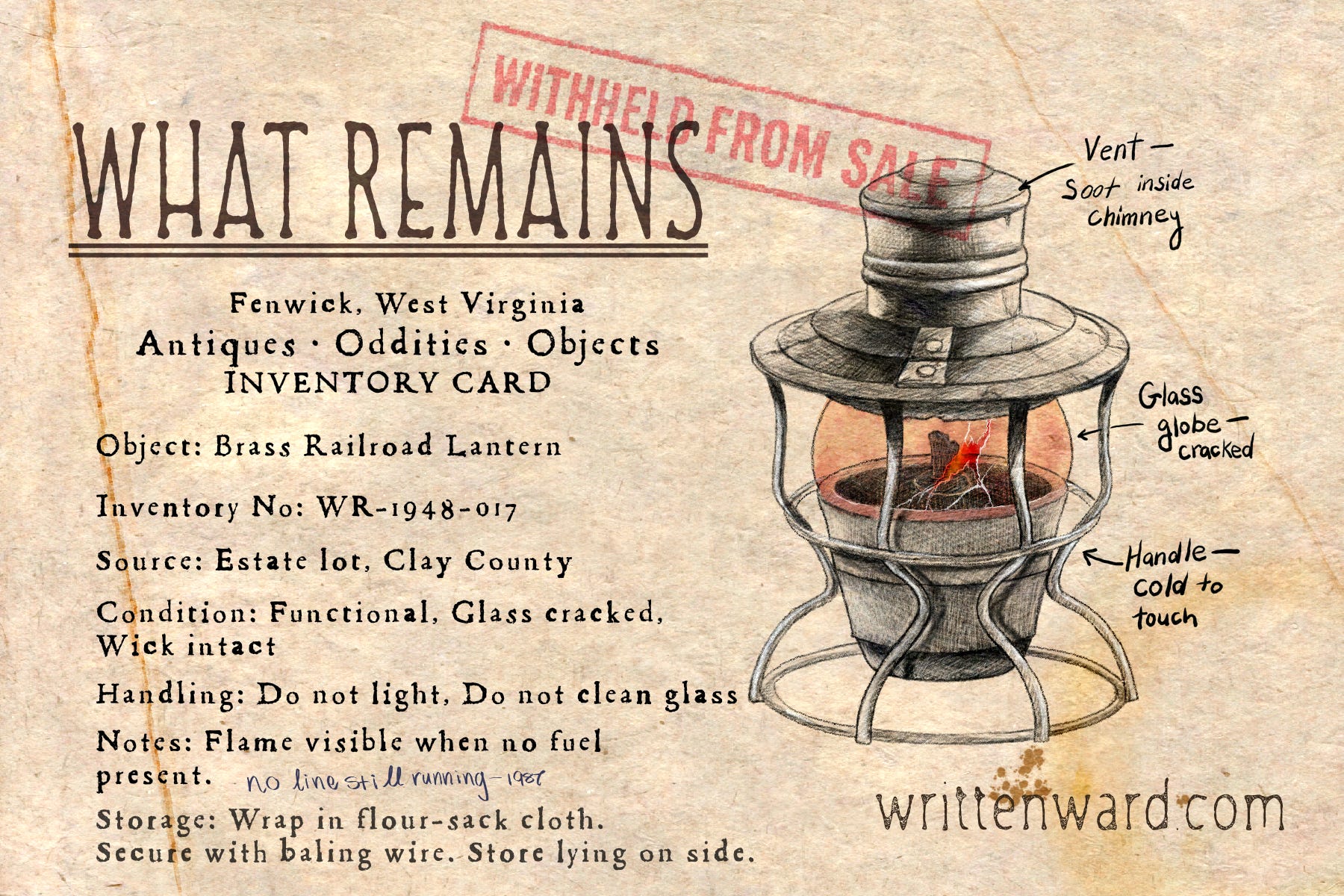
I laid the card beneath the light. Bessie had dictated the original entries to Minnie, who typed them onto cards nearly the size of a sheet of paper. I’d considered copying everything into a journal, but that would only create another record for someone to find—or overlook. So I’d started adding my observations directly to Bessie’s cards. There was plenty of room, and it kept everything we knew in one place.
Under Handling, Minnie had typed two instructions: Do Not Light and Do Not Clean Glass. Only the second had been underlined. In fact, it was the only underlined phrase on any of the forty-three cards.
Why that warning?
Farther down, Minnie had typed another note: Flame visible when no fuel present. Beneath it, Bessie had added something in ballpoint pen: No line still running ~1987.
I understood the typed note, or thought I did. “Line” almost certainly meant the railroad. But what did a dead rail line have to do with a flame that burned without fuel? And why had Bessie added the year?
I picked up my old number-two pencil and began sketching the lantern in the empty space beside her notes.
Truth be told, I was a little bitter. I’d spent my childhood working at What Remains, helping Bessie in whatever ways I could, but I’d never possessed her gift. Grandma Minnie kept the books and handled the ordinary work of keeping the shop open. I carried boxes, swept floors, and did whatever else Bessie asked of me. She taught me some of the stranger parts of her work. I was always the helper. A witness rather than a practitioner.
I resented that. I wanted the secret knowledge—the magic and wonder of it all—but it had never been mine.
I’d witnessed what Bessie could do time and again, whether she was mixing a poultice for a child with a winter cough or making a charm against the evil eye. Some people around Fenwick called her a granny witch, though never to her face. Mostly, they just came when they needed help.
People around here had depended on her. Now that I was running What Remains, some of them had begun looking to me. That scared me. I’d inherited her rules, but not her understanding. Back then, I was just trying to figure it all out before someone got hurt.
Then Nate came downstairs.
“Hank?” he called.
“I’m over here.”
Nate stepped around the corner and found me working on the drawing. He studied it for a moment, then looked toward the lantern on the shelf.
“Ya know, your cell phone has a camera. You could just take a picture.”
“I know.”
“Then why are you drawing it?”
“Because a picture shows me what it looks like. Drawing makes me see it.”
While I was speaking, Nate turned and walked over to the shelf where the lantern lay on its side. He reached toward it, and I thought he meant to stand it up.
“Don’t. Bessie’s card says it has to stay lying on its side.”
Nate withdrew his hand but leaned closer. “There’s a red glow inside the gl—hold on. Might just be something behind the soot.” Before I understood what he meant, he dragged his index finger across the globe. “This thing is a mess.” He looked down at his grime-darkened finger and wiped it across his denim jeans, leaving a smear. “It’s brighter now. See?”
He stepped aside. Through the streak he had cleared, I saw a small red flame trembling behind the cracked glass. I was on my feet in an instant. “Why would you do that? I’ve told you not to touch the things down here!”
“Calm down. All I did was clean it a little bit.”
“I know. That’s the other warning on Bessie’s card. Do not clean glass. It’s even underlined.”
Nate paused at that news, but only for a second. “Well, nothing happened to me. I’m still okay. Judgment did not fall from the heavens or something. I do wonder where the light inside there is coming from, though…” He leaned closer. “It’s so strange.”
“Nate, this is serious!” I said as I grabbed his hand to inspect his finger. It was still covered in soot. I led him over to the workbench where I kept some rubbing alcohol for cleaning. I poured some on an old rag and wiped at his finger. The stain remained. On the shelf behind us, the lantern burned a little brighter.
Next in Written Ward
Written Ward follows a four-week rhythm during each season:
- Week One — Original Fiction: A new installment of What Remains
- Week Two — Spoken Ward: A short story worth discussing, what caught my attention, a few questions for its author, and another story recommended by that author
- Week Three — Original Fiction: The next installment of What Remains
- Week Four — Found Treasures: A personal collection of things I’m glad to have found and people whose work I think deserves attention
That rhythm will continue throughout the season. I’ll announce the season finale and the following intermission in advance.
Next week brings the first episode of Spoken Ward. What Remains will return in week three.

In the meantime, I’d like to know: Would you have cleaned the glass? You can reply to this email or leave a comment below.
Thank you for reading and for joining us from the beginning.
If this installment made you think of someone who might enjoy a strange little shop and the things locked away in its cellar, please consider sharing it with them. Personal recommendations are how Written Ward finds new readers.
Until next week. Mind the rules!
I don’t know if I would…. But I knew the glass was going to be cleaned
A lamp cleaned in the first act has to go off in the third