

Welcome back to What Remains, an ongoing serial from Written Ward.
Whether you’ve been with us since that first trip into the cellar or if you’ve only just found your way to Fenwick, I’m glad you’re here.
This story is meant to be read in order, so new readers—or anyone who might need a refresher can catch the previous episode by clicking on the link below.

For everyone who’s following along, I hope you’ll share your theories or ideas about what’s going on here. Thank you for being part of this little community. Now, let’s get back to the story.
The Stain Part 3: One Week
The cellar felt colder than usual. No matter. I wasn’t going to be there long. Not like before.
The lantern was where I’d left it, lying on its side. The flour sack that had served as its cowl lay in rumpled folds beneath it.
I gathered the cloth and wrapped it around the lantern the way I’d seen Bessie do it: the left side first, then the right, with the loose end tucked up under the base. The flour sack felt coarse against my hands. As I drew it tighter around the globe, the red flame flickered through the weave. For a second, it lit the words Richwood Wholesale Company before disappearing beneath the next fold.
Minnie had told me how people used to cut old flour sacks into dresses. I wondered if Bessie had once meant to make something for her little girl from this very one. I didn’t let myself finish the thought.
I wound the baling wire around the bundle. It scraped and bit into the cloth, making a soft metallic groan as I pulled it tighter. Three turns should have been enough. I gave it five. Then I tugged at the cloth, checked the bottom, and bent down to make sure no light escaped from the far side.
It looked the way Bessie had left it. I told myself that mattered. I had to believe that it was enough.
Before leaving, I counted the other objects in the cellar. All forty-three were still where they belonged. I counted them again, as if the numbers might change. Nothing else appeared to be disturbed.
I made my way up the stairs and locked the heavy door behind me. It was good to be out of there.
The sock monkey was still lying on the counter where Minnie had left it before Nate took her home. I grabbed it and carried it into the back room where I set it beside the inventory card I’d started. The table back there was larger, and I needed room to think.
There had to be a way out of this. I only needed to see things clearly enough.
I looked down at the monkey. Was it harmless, or did it belong in the cellar beside the lantern? I added the word Handling to the card and wrote: Unknown. Do Not Move. It wasn’t much of an instruction, but for now it would have to do.
I cleared the table and unrolled an old map Bessie had tucked behind a copper fish mold. Why she’d kept it there was one of the lesser mysteries she’d left for me. One edge curled toward the middle, so I weighted it down with one of the Foxfire books. A WPA collection of West Virginia folklore held another corner, and a history of the B&O Railroad lay open beside it.
The map showed the old line running from the railyard in Cowen and heading south through Camden-on-Gauley, Allingdale, Fenwick, and eventually Richwood where it would turn around and head back towards Cowen. I found the place where the Fenwick station had stood and marked it with a red X. What Remains stood across the road from where the station had been and where the Post Office was now.
On index cards, I wrote down the progression that Minnie had described.
SOOT.
WHISTLE.
RUMBLING.
THE MAN.
ONE WEEK.
I pinned the cards in a row across the corkboard that hung next to the back door. Then I began with the indexes, searching the books for any references to Fenwick, lanterns, conductors, accidents, and every variation of ghost train I could think of.
Nothing.
By the time Nate returned, I’d covered the table and half the corkboard without finding a single thing that could save him.
The back door opened before I could put the pen down. Nate stood framed in the entrance with rain on his coat.
“How is she?”
“Asleep, I think,” Nate said. “Tildie came over and sat with her. She didn’t say much.”
That helped, I think. It didn’t make my guilt go away, but knowing she was resting was something. I wanted to ask whether Grandma had mentioned me, but I noticed that Nate was looking at the table. The sock monkey lay beside its inventory card. I noticed that one of its button eyes was loose. Nate’s attention moved past the monkey to take in the map and all of the books that were holding it down. He paused for just a moment when he saw the red X. The cards on the corkboard brought a smile to his face. “Murderboard much? Looks like you’ve been busy.”
It wasn’t quite approval, but I accepted it anyway. I stepped between him and the table and picked up the red marker. If I was going to explain this, might as well look like I knew what I was doing. “I’ve got it all figured out. Three parts. Simple, elegant, almost impossible to misunderstand.”
“That last part feels directed at me.”
Good. He was keeping up. “Part one: keep you alive. Part two: figure out what the lantern did to you. Part three: reverse it. Just have to do it all before the deadline… eh, before next Tuesday.”
“Nice save,” Nate deadpanned. “Can I just point out that ‘keeping me alive’ isn’t really a plan?”
“Keeping you alive is the standard by which every other part of the plan will be judged.”
Nate stepped up to the corkboard and read the cards. “Soot. Whistle. Rumbling. The man. One week.” His fingers trailed over each of the cards until he got to the last one. “And after this?” His finger tapped the ONE WEEK. “Seems like you left out the card after this. You know. The one that would say DEATH.”
“I didn’t forget it. I rejected it.”
“You rejected it?”
I nodded. “That’s right. Rejected. Didn’t fit my plans. I revised outcome.”
Nate looked at me long enough to make me wish I’d chosen a different answer, but I was committed. “Not gonna be an issue. We’ll have it all fixed up before we need another card. Besides, have you priced index cards lately? I’m not going to waste one on an outcome we’ve already canceled.”
Something tugged at the corner of Nate’s mouth. For a moment, he looked like the cousin I remembered, the kid I’d chased through this place. Then moment passed, and he tapped the ONE WEEK card. “No starting date.”
“I know. We assume the worst of the possibilities.” I put my hand on the map where the old railroad bridge crossed the Cherry River just outside. We’d played on that bridge as kids.
“I’ve got a few rules that you’ll need to follow till we get all this stuff sorted. Rule one: you don’t go anywhere alone.”
“I just got back from taking Grandma home.”
“That occurred before the policy took effect.” I tapped the map. “We’re not applying it retroactively.”
“How convenient.”
“Rule two: no driving, climbing ladders, going onto rooftops, and don’t you dare go near the river!” I set the marker down on the table and ticked off the remaining rules on my fingers as I said them, “no handling open flames, and you don’t operate machinery. Don’t even cross the railroad bridge.”
“The railroad bridge? I haven’t crossed that thing since we were kids. What do you think I’m going to do—walk to the gas station for two hot dogs for a dollar?”
“They’re good hotdogs.”
He let out an exasperated sigh. “Fine. Is there anything I am allowed to do?”
“Sit, breathe… maybe eat a slice of that pie Lori gave you.”
“You know people choke on food, right?”
“Look, I can’t do everything for you. Cut it up into really small bites. Come to think of it, we should probably get Lori to come sit with you. That way, she’ll be here if you need mouth-to-mouth resuscitation.”
“That’s not how you treat choking.”
“Then don’t choke. Great. We’re back to the original plan. Thank you for cooperating.” I pinned a new card beneath the other ones. This care read: NO CELLAR. “You’re not going back into the cellar.”
“I own half of this store. Seems like that would include the cellar.”
“Then consider this a temporary injunction filed by the owner of the other half.”
He took the card down. I put it back.
“The cellar didn’t cause this. I’m the one who touched the lantern.” Nate moved the ONE WEEK card farther away from the one that said THE MAN.
“And I’m the one who left the lantern uncovered. Between the two of us, we’ve done a pretty good job at showing why the cellar needs stricter admission standards.” I put the ONE WEEK card back into the right position. “What we know is that Bessie’s daughter wiped the lantern. Her fingers became stained. She heard sounds no one else could hear. A man showed up and told Bessie to get her ready. She drowned a week later.”
“That’s all we know,” he gestured in a way that took in the five cards. “Everything else is just guesswork.”
“Yes. But what we know should be enough to keep you away from the water.”
“None of this proves the lantern caused that child’s death. It doesn’t prove the man arranged it. Doesn’t prove that monkey is anything more than a stuffed animal.”
“Technically, you’re right,” I said.
“Then stop talking like you’ve solved it all.”
I put the marker down. For once, I didn’t have an answer ready. “Look, the fact that we don’t know everything makes these precautions more necessary, not less.”
“My point is that you can’t eliminate every possible accident. Not for a week.”
My voice came out lower than I intended. “Somewhere in all those possible accidents is the one that kills you. I’ve got to figure out a way to stop that one from happening.”
“Let’s stick to what we’re good at,” I said, tracing the vanished railroad with my fingertip. “I’ll take people. You take records.”
“I’ll track down the Clay County collector, call around Fenwick and Richwood, and find out whether any of the old railroad people are still alive. You find out when passenger service ended, when freight stopped running, and who worked that route. Employment records, accident reports, maintenance reports—anything the railroad left behind.”
Nate looked from the corkboard to the stack of books. “You’re giving me all the tedious work.”
“I’m giving you work that let’s you lean into all those computer smarts you learned in California. You do that part and I’ll deal with the people.”
I pushed the sock monkey’s inventory card to the side, revealing the one that had started all of this. I tapped the drawing I’d done of the lantern. “Nate, we’ve all got gifts, and I need yours. If that lantern belonged to the railroad, it should have some kind of number or a mark that identifies it in some way. If it has a number, there’s a record. And if it’s got a record, I know you can find it.”
Nate took the notebook where I’d started to record information I thought might be important. I kept going on and trying to fill him in on everything I thought was important. I was still talking about freight manifests when I noticed that he’d stopped listening. He was facing the wall. The one that was on the same side as where the Post Office was and where the old train station had stood. His head was cocked to the side the way a dog does when it’s listening.
“Nate!”
He looked at me like he was waking up from a dream. “When did Minnie say the trains stopped coming through Fenwick?”
“Nineteen eighty-seven. Why?”
He kept listening.
“Because I can hear a whistle.”
I stopped talking.
At first I heard only the rain smacking against the back window. Outside, I hear a passing car on its way to Richwood. The tires hissed over the asphalt. “Where?” I asked. “Can you tell how far away?”
Nate shook his head. “Sounds like it’s somewhere over where the station used to be. I don’t know. It’s... close enough to hear, but still kinda muffled.”
He pressed his thumb to his finger, rubbing at the soot. “I heard it on my way back from Minnie’s too. It went quiet for a while, but now it’s started again.”
I couldn’t hear anything.
Nate tilted his head to the side. “I think I can make out something other than the whistle now. It’s like clattering sound. Wheels crossing over timbers and scraping against metal.”
I glanced at the cards: WHISTLE. RUMBLING. THE MAN. I heard three sharp knocks at the back door. Without thinking, I opened it before asking who was there.
There was a man I’d never seen before. He stood on the back steps in the rain. He wore a dark wool coat and a conductor’s cap that he’d pulled low over his eyes. The coat’s buttons were made of brass that had gone dull with age. In one hand he carried a battered leather folio. Before we could say anything, he pulled a watch, that hung from a chain, out of a pocket to check the time.
The most striking thing about his presence was the overwhelming smell of creosote and machine oil. Nate’s coat had been dripping wet when he’d come in from the rain, but somehow this man’s uniform was completely dry.
He entered the room without asking.
“Hey buddy, you can’t just walk in here,” I said. “We’re not buying anything you’re sellin’.”
The man didn’t smile. Instead, he opened his folio and consulted a form. “Which of you is responsible for outgoing freight?”
“We don’t have any outgoing freight,” I said. “We’re not shipping anything.”
The conductor consulted his form. “Nathaniel Parsons?”
Nate started to answer. “No.” I glared at Nate. “He’s not available.”
The man looked past me and stared directly at Nate. His gaze dropped to the hand hanging at Nate’s side and settled on the soot staining his finger.
“Tender confirmed,” the conductor said.
It felt like the room was getting smaller. “Who confirmed it?”
“That mark,” he gestured to Nate’s hand with a nod of his head, “constitutes acceptance.”
Nate looked at me. “What consignment?”
The conductor gestured toward the soot-stained finger. “Nathaniel Parsons.”
My cousin’s name hung in the air, and the joke I wanted to make… well, it wasn’t time for jokes.
I put my hand on Nate’s arm. “He isn’t freight. He’s a person.”
The conductor made a note on his form. “Our line only deals in freight. Passenger service at Fenwick has been discontinued.”
“Nate’s not going anywhere. He’s not traveling. We refuse shipment. The station has been gone for decades. They tore it down years ago! Even the tracks have been pulled up. There’s nothing here for you to collect.”
“Travel is not required. Collection has been scheduled.” He turned a page. “Tendered freight cannot be refused after entry. Fenwick remains a designated collection point.”
“The line closed in 1987,” I said.
The conductor was unfazed. “My orders remain unchanged,” he replied.
I said, “You can’t collect a person. You just can’t.”
His pen didn’t stop. “Classification is not my concern.”
Nate went still. He had that focused look. Same one he had when we were kids trying to solve some puzzle he couldn’t set down. That’s how Nate looked at the conductor.
“What railroad?” Nate asked. He was probing now. Looking for a solution.
The conductor kept his silence.
“Which route?” Nate continued.
The conductor’s pen moved, but he didn’t speak.
“Who authorized the collection?”
No answer.
“Who’s the receiver? Who are you shipping it to?”
The man checked the form. “Consignee unassigned.”
The conductor started to close the folio.
“Can we dispute it?” Nate asked.
“Objections are noted after presentation,” the conductor said, reaching into his leather folder and pulling out a form. The paper looked decades old, but the name across the top had been typed in fresh ink: Nathaniel Parsons.
He signed the form and tore the top sheet free. Then, he punched one corner with a metal instrument. The snap was loud. It was like a gunshot in the dark. You’re not expecting it and then boom. Nate hissed. He pressed his stained finger into his palm. I swear that for a second or two, that soot stain got even darker.
Then the conductor laid that notice right on the map. He put it down right on top of my red X. He examined it for a moment and then straightened it out a bit and said, “The consignment is to be presented at the Fenwick platform next Tuesday at 9:14 p.m.”
“He won’t be there,” I said.
“Failure to present the freight at the appropriate time will not cancel collection.”
“You’re not taking him.”
The conductor looked at me. It was the first time he bothered to make eye contact with me.
“You are not listed on the consignment.” He closed his little book and then checked his pocket watch one more time like he needed to know how long he’d spent talking to us. Then he turned toward the back door.
“Wait,” I said. “What is this?”
He didn’t answer. Just stepped back out into the rain. I followed a second later, but the steps were empty. The path around the back of What Remains that followed the river around the building was empty. There weren’t any footprints in the mud, no cars passing by and no sign of a man walking down the street. He was just gone.
When I stepped back inside, Nate was standing next to the map. He stood there just staring at the yellow notice.
I closed the back door and locked it. For a second, neither of us said a word. The rain continued to pound away roof overhead. The clock ticked. Nate shifted his weight and an old floorboard creaked.
“Don’t touch it,” I said. I don’t know why I said it, but it didn’t feel safe in that moment.
“But, you wanted me to examine the records.” He said it with a smile.
“Yeah, but I meant records that hadn’t been hand-delivered by a dead man.”
It wasn’t much of a joke, but it was enough to lighten the mood a bit. I got the old Kodak that Bessie had sometimes used for new arrivals and photographed the notice where it lay over the red X, then again from lower down. The flash reflected sharply off the paper, but I took two more in case the first one didn’t come out.
The paper was thin, softened at the folds. The preprinted ink was old and uneven. It had faded a bit. The name at the top, Nate’s name, looked like it had been typed this morning.
“Baltimore and Ohio Railroad,” he read. “Form 12-C. Route: Cowen to Richwood. Origin: Fenwick. Place of presentation: Fenwick platform. Consignment: Nathaniel Parsons.”
“Who’s it going to?” I asked.
He looked at the line beneath his name: “Consignee: unassigned.”
“Consignee is the person who’s gonna pick it up, right?”
“Yeah. It’s for whoever is receiving the shipment,” Nate replied. “What does it mean if you don’t have a receiver though?”
No one said anything for a moment, but I couldn’t take the silence anymore. I finally said, “I’m not sure, but it doesn’t sound good.”
I shouldn’t have said that. I could tell he was nervous, but it was good to see him fall back on trying to solve the problem. He copied it all down into his notebook and circled the part about the consignee. Like he was going to come to it later.
“So I’ve got seven days,” he said. “Just like Bessie’s daughter.”
I looked at the board. Suddenly that card that read ONE WEEK felt a lot more menacing. Before this moment, it had belonged to Minnie’s story. Now it was a coming deadline that meant something to us.
I took the card down and wrote the date seven days from now under the words ONE WEEK. Then, I added 9:14 PM under that. These newest words were written in letters that were more crooked than the ones I’d originally written. I pinned it back where it belonged.
Then, I noticed something at the bottom of the form. A signature in small, slanted letters.
E. M. Vallow. Below that name was a number: 417.
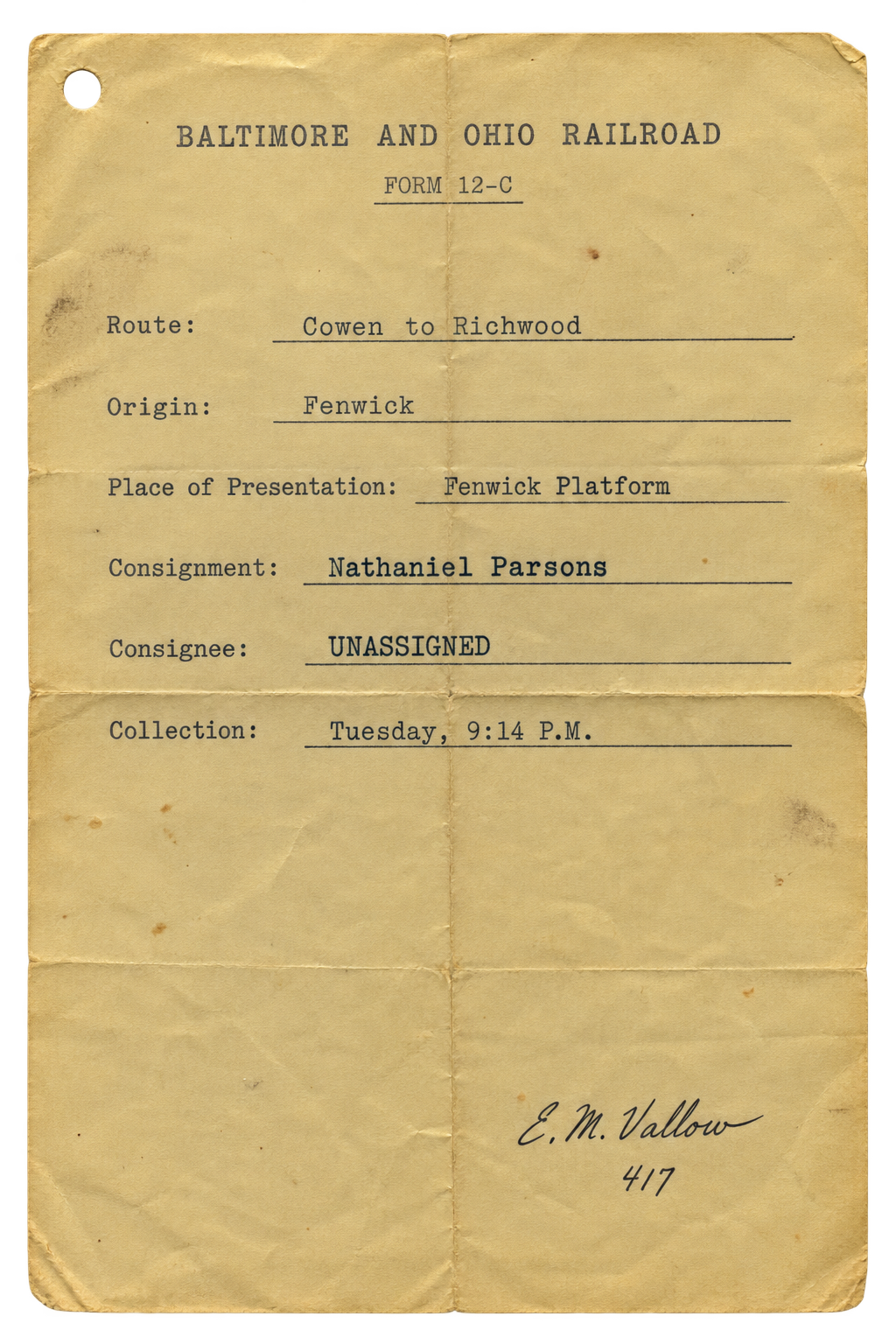
Nate copied that into his notebook as well. Now, we had an exact time, the conductor’s name, and what looked like an employee number. It wasn’t a solution, but it was a start… and at least that was something.
Next in Written Ward
Written Ward follows a four-week rhythm during each season. We are in Week One.
- Week One — Original Fiction: A new installment of What Remains
- Week Two — Spoken Ward: A short story worth discussing, what caught my attention, a few questions for its author, and another story recommended by that author
- Week Three — Original Fiction: The next installment of What Remains
- Week Four — Found Treasures: A personal collection of things I’m glad to have found and people whose work I think deserves attention
That rhythm will continue throughout the season. I’ll announce the season finale and the following intermission in advance.
Next week, I have an interview with Scoot where we discuss his story

Before you leave, Which detail from this episode do you think Hank should pay closest attention to… and why?
Thank you for reading and for joining us from the beginning.
If this installment made you think of someone who might enjoy a strange little shop and the things locked away in its cellar, please consider sharing it with them. Personal recommendations are how Written Ward finds new readers.
Until next week. Mind the rules!
The name. But the time also might be significant if it’s not 7 days to the minute when Nate touched the lantern?
Well I’d have said the note that one of the sock monkeys eyes was loose… trouble is… X marks the spot 😉